This event has been ended!
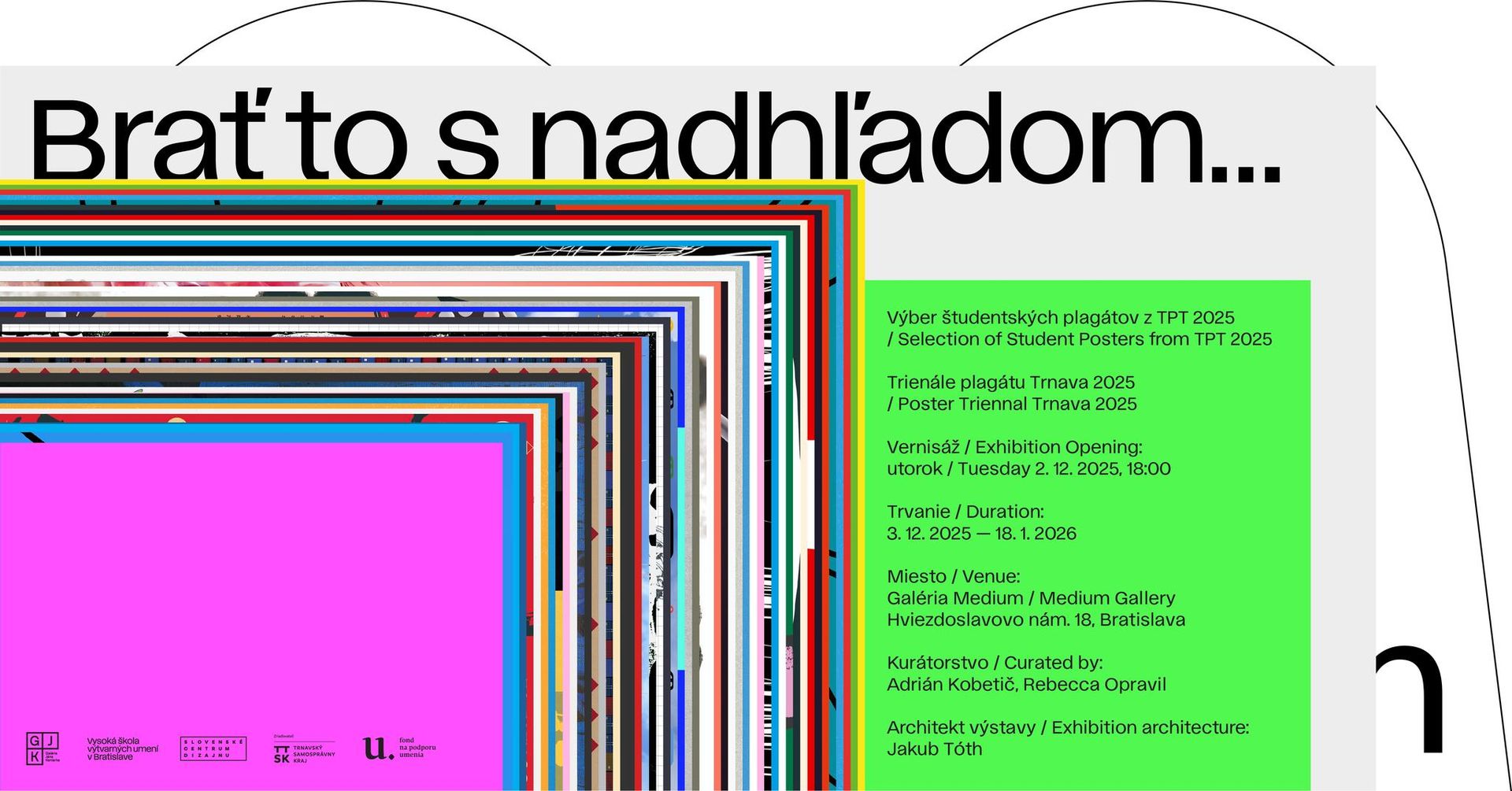
Trienále plagátu Trnava 2025 v Galérii Medium: Brať to s nadhľadom
Trnava 2025 poster triennial in the Medium Gallery: Take it in stride
Event by: Galéria Medium / Medium Gallery
Location: Galéria MEDIUM, Hviezdoslavovo námestie 178/18, Bratislava - Staré Mesto
Talks & discussions, Exhibitions
About event
Taking it from Above
Poster Triennale Trnava 2025 / Poster Triennal Trnava 2025
Selection of students' posters from TPT 2025
Curation / Curators: Adrián Kobetič, Rebecca Opravil
Exhibition Architect / Exhibition Architecture: Jakub Tóth
Opening / Exhibition Opening: Tuesday, 2.12.2025, 18:00
Duration of the exhibition: 3.12.2025 - 18.1.2026
Place / Venue: Galéria Medium, Hviezdoslavovo nám. 18, Bratislava
Triennale Plagátu Trnava long-term observes how the medium of the poster changes over time, and how the way we read it changes. This year was the twelfth year of this international competition, which tracks current visual and communication trends in world poster design and evaluates works in two categories – professional and student. The student category plays a key role in this process: it represents an environment where new visual procedures are created, where the boundary between communication, authorial gesture and visual experiment is tested. The current year, continuing the long tradition of international confrontation, shows that young authors no longer perceive the poster as a static medium, but as a moving system responding to cultural pressure, political gestures or regrouping of social values. Therefore, the selection of fifty final posters does not create a homogenous whole, but rather a network of different approaches, which lead a thoughtful, although not always harmonious, dialogue.
The title of the exhibition Taking it in perspective works as a disposition – a fine adjustment of optics that allows us to see in the student work not only visual skill, but especially the ability to think about the medium itself. The works represented cover the entire range of topics that shape visual communication today: from environmental and social issues to the analysis of visuality itself, its overcrowding, acceleration and fragmentation. In many posters there is a need to slow down, to name the problem more precisely, or to create a space where the image can exist outside the system of immediate interpretation. Others work purposefully with irony, microgestures or reduction. They are united by a precise, critical observation of the contemporary world and a willingness to look for new forms of visual argumentation.
The exhibition concept itself slightly shifts the way we are used to approaching posters. Traditional verticality gives way to a different orientation – perhaps closer to the body's movement than to the gaze. Here, the poster behaves less like an image and more like an object that demands a new way of reading. The viewer is not forced to adopt a single perspective; its position becomes part of the work. Stored layers, repeated formats and seemingly simple gestures open up a field of interpretations: about the excess of images, about the need for distance, about the pressure of the visual environment, or, on the contrary, about its fascinating diversity. The exhibition lets these meanings flow freely and allows each visit to compose them anew. The concept thus does not offer a definitive answer to what a poster should be today - rather, it creates a situation in which this question can be responded to in several ways.
Partners: University of Fine Arts in Bratislava, Slovak Design Center
This project is implemented with the financial support of the Trnava Self-Governing Region.
The Art Support Fund supported it from public sources.
/
The Trnava Poster Triennial has long been monitoring how the medium of posters is changing over time and how the way we read them is changing. This year marked the twelfth edition of this international competition, which observes current visual and communication trends in global poster design and evaluates works in two categories – professional and student. The student category plays a key role in this process: it represents an environment where new visual approaches are created and where the boundaries between communication, authorial gesture, and visual experimentation are tested. This year's edition, continuing a long tradition of international confrontation, shows that young authors no longer perceive the poster as a static medium, but as a dynamic system responding to cultural pressure, political gestures, and the reshuffling of social values. The selection of fifty final posters therefore does not create a homogeneous whole, but rather a network of different approaches that together lead to a thoughtful, though not always harmonious, dialogue.
The title of the exhibition, Take it from Above, serves as a disposition—a subtle adjustment of perspective that allows us to see not only visual skill in the students' work, but above all their ability to think about the medium itself. The works on display cover the entire range of topics that shape visual communication today: from environmental and social issues to the analysis of visuality itself, its overload, acceleration, and fragmentation. Many posters express the need to slow down, to name the problem more precisely, or to create a space where the image can exist outside the system of immediate interpretation. Others deliberately work with irony, micro-gestures, or reduction. What they have in common is a precise, critical observation of the contemporary world and a willingness to seek new forms of visual argumentation.
The exhibition concept itself slightly shifts how we are used to approach the poster. Traditional verticality gives way to a different orientation – perhaps closer to body movement than to the gaze. Here, the poster behaves less like an image and more like an object that requires a new way of reading. The viewer is not forced to accept a single perspective; their position becomes part of the work. Stored layers, repeated formats, and seemingly simple gestures open up a field of interpretations: about the excess of images, the need for distance, the pressure of the visual environment, or, conversely, its fascinating diversity. The exhibition allows these meanings to flow freely and enables each visitor to reassemble them anew. The concept does not offer a definitive answer to what a poster should be today—rather, it creates a situation in which this question can be answered in multiple ways.
Partners: Academy of Fine Arts and Design in Bratislava, Slovak Center of Design
This project is financially supported by Trnava Self-Governing Region.
Supported using public funding by the Slovak Arts Council.
Events in Bratislava today · Events in Bratislava this weekend