This event has been ended!
HYB4 Galerie: Jan Vytiska: Do vsi, kam jsi nikdy neměl zabloudit | Komentovaná prohlídka
HYB4 Gallery: Jan Vytiska: To the village where you should never have strayed | Guided tour
Event by: Kampus Hybernská
Location: Kampus Hybernska, Hybernská 998/4, Praha 1
Talks & discussions, Exhibitions
About event
Guided tour and conclusion of Jan Vytiska's exhibition: To the village where you should never have strayed.
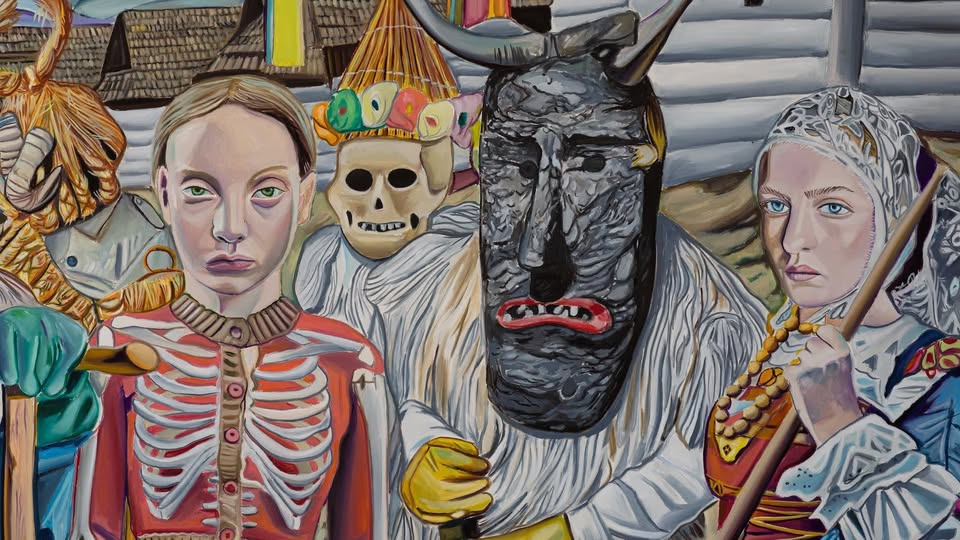
Jan Vytiska's work represents a distinctly recognizable and established visual manuscript in the Czech context. The exhibition in the gallery offers a comprehensive entry into his pictorial world, which develops as a unique mythological open-air museum of characters, rituals and symbols. It is this ability to connect local folklore imagination with the universally comprehensible language of contemporary painting that makes Vytisk's work readable even in an international context.
Curator: Michal Štochl
C.0 HYB4 The gallery is open from Monday to Saturday from 10:00 a.m. to 8:00 p.m. The entrance to the gallery is through the Kampus Café.
"Repeatedly, during conversations with the artist, I felt a tendency to cross the line of conformity and suggest to Vytiska (b. 1985) that he should take a different path than the one that is firmly connected with myths and rumors somewhere below Radhoště. However, Vytiska just paused quietly and, looking at the ground, it was clear to me at that moment that it was not a direction that I should continue to open."
The prints systematically develop a visual language inspired by the regional traditions of Wallachia, which, however, transcends the local context and opens up more universal questions of the relationship between man, nature and myth. His paintings work with the tension between the archaic pictorial world and contemporary experience.
In his work, figures and beings appear that oscillate between human, animal and mythical. This motif world is set in an environment that evokes a rural landscape, but is transformed into a psychologically dense space of symbols and metaphors.
The painting layer itself plays an important role. Next to the strong figurative motifs, detailed work with ornament, textiles, folk decor and color structure appears, which creates a contrast between the subject matter and the visual sensibility of the painting.
"It is this layer of detail that repeatedly fascinates me — prominent lace embroideries, folk ornaments and symbolic elements, all only subliminally readable in the environment of beings and events. The color is brilliant and in its tones it is shown that the darkness the images also contain silence and subtlety, which shines through these details. And this is precisely where Vytiska's uniqueness lies — it is not just caricatures of the world around us, but small floral and symbolic moments that open up space for the human soul to read itself." The viewer is confronted with a visual world that refers to folklore narratives, but at the same time moves them to the position of an imaginative, almost mythological space.
Within this framework, Vytiska's painting moves between narrative and symbol, between irony and seriousness, between tradition and its contemporary reinterpretation.
"Time stops here — it is a place where 'you have nothing to do', because you have found yourself in the wrong place in the wrong place at the wrong time, in the middle of the carnival of beasts and angels, feasts of demigods.'